

There's Nothing Like Boys of Summer
What Happened at the World Premiere of Third Base Surprised Even Us
We knew people were excited about the world premiere of Boys of Summer: Third Base at the World Parkinson Congress in Phoenix.
We did not expect what happened next. The line to get in snaked across the conference floor. Some knew about the first three films, others were coming in blank. When the doors opened, the seats were quickly filled. The spillover audience lined the walls. Others sat on the floor. By the time the lights dimmed, the room was beyond standing room only.
But it wasn't the crowd that surprised us. It was the way they responded: they laughed…Loudly.
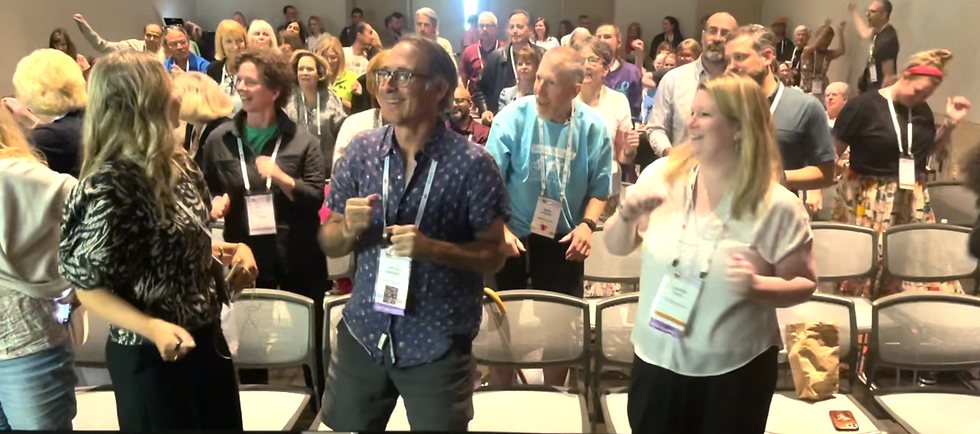
They cried, they cheered, they shouted responses at the screen as if they were in the movie. It was a room full of people seeing themselves reflected back in ways they rarely have the opportunity to experience.
Afterward, one audience member embraced me and said something I haven't stopped thinking about: "The Parkinson's community needs you."
While I appreciate the very kinds words, I don't believe she was just talking about me. I think she was talking about us - our stories. Especially the ones people don’t know yet.
More Than Tremors

For decades, Parkinson's disease has largely been understood through a narrow lens as tremors, movement difficulties, balance problems. These are the visible symptoms that most people recognize.
But Parkinson's is much more than that.
It affects mood, cognition, sleep, relationships, identity, and family dynamics. It can include anxiety, depression, apathy, hallucinations, delusions, and a host of non-motor symptoms that remain poorly understood by the public and often under-discussed even within healthcare settings.
Throughout the week at the World Parkinson Congress, I repeatedly heard a similar response from people encountering these realities:"I didn't know that was Parkinson's."
Those six words may be among the most important words spoken during the conference.
Because awareness is where change begins.
The Stories We Don't Tell

My father, Dan, was diagnosed with Parkinson's disease twenty-five years ago. When he was diagnosed, neither of us understood where this journey would lead. We certainly didn't understand hallucinations, delusions, or the complicated grief families experience while watching someone they love change over time.
Many of the most difficult parts of Parkinson's are invisible. And invisible problems are often misunderstood.
That's one reason stories matter.
Stories create understanding where facts alone often cannot. A statistic can tell us hallucinations occur. A story can help us understand what it feels like. A clinical description can explain caregiver burden. A story can help us engage with the person going through it, showing that they and we matter.
Something Bigger Than a Movie
What happened in Phoenix showed me, once again, that people living with Parkinson's disease, and we who love them, are hungry for opportunities to tell the truth about their experiences.
Not just the inspirational or tragic parts. The whole story. The funny, heartbreaking, absurd, hopeful, and fully human parts.
That's what made the premiere so special. The audience wasn't simply watching a film. They were participating in a conversation and recognizing themselves in each other's experiences.
They were saying, "Yes, and…that's me too."
In a world where so many people feel isolated, that recognition matters a lot.
A Call to Listen
This isn't a criticism of healthcare providers. In fact, many neurologists, movement disorder specialists, therapists, nurses, and researchers are among the strongest advocates for people living with Parkinson's.
But Parkinson's is experienced every day. Clinical care is necessarily episodic.
The lived experience exists in the space between appointments, where community lives, support groups matter, and families struggle and adapt – that’s where stories are born.
The more we can bring healthcare providers, researchers, people with Parkinson's, care partners, and families into conversation with one another, the stronger our collective response becomes.
Not because any one group has all the answers. But because each of us has part of the story.
There's Nothing Like Boys of Summer
Following the Third Base premiere, I keep coming back to the same thought: There's nothing like Boys of Summer. It creates a space where people can see themselves, and each other, with honesty, humor, vulnerability, hope, and electric inclusivity. We all play.
That first screening reminded us again, Parkinson's is not just a medical condition. It is a human experience.
The more we understand that, the closer we get to the world we all want to build. A world where no one has to say: "I didn't know that was Parkinson's."
Keep checking in at www.bosmovie.com for more information on how you can see the latest Boys of Summer film, Third Base.


Comments